Subpopulations and states of dendritic cells in human tumor-adjacent and tumor tissues, a study published in Nature Immunology – Corresponding author: Charles-Antoine DUTERTRE, BOISSONNAS team
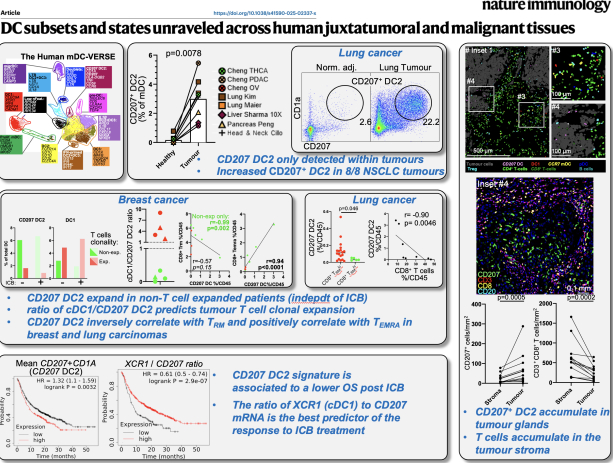 Dendritic cells (DCs) are professional antigen-presenting cells. While plasmacytoid DCs (pDCs) are poor antigen-presenting cells in their stable state, myeloid DCs (mDCs), which include DC1, DC2, and DC3, specialize in T cell activation.
To generate an atlas of human mDCs, we integrated mDCs from 13 tumor tissues from 40 single-cell RNA sequencing (scRNAseq) datasets to create the mDC-VERSE. We characterized the subsets and “states” of dendritic cells in these tissues.
Most of the tumors studied contained a population of CD207+ DCs, a subset of CD1c+ DCs (DC2+DC3), which accumulate in tumors of all carcinomas included in our study. Their expansion is: (1) inversely correlated with T-cell clonality and the frequency of tumor-resident CD8+ T cells (TRM); (2) positively correlated with “exhausted” effector memory CD8+ T cells in tumors (TEMRA); (3) associated with poorer survival in patients treated with immune checkpoint inhibitors (ICBs).
Like CCR7+ mDCs (a state common to DC1, DC2, and DC3), we discovered that CD207+ DCs are a state common to DC2 and DC3. Transcriptomic and spatial immunohistofluorescent analyses of single cells from human carcinomas have shown that lymphocytes and most dendritic cells are enriched in the tumor stroma, while CD207+ DCs are mainly integrated into tumor nests. This DC-VERSE is a valuable resource available to the scientific community for studying DCs in healthy and pathological situations.
A study published in Nature Immunology on December 8, 2025

Incoming seminars
Unraveling the immune tumor micro-environment using spatial transcriptomic at the single cell level :
«Marine LOUARN - 1:00 p.m. – ZOOM webinar»
HIV-1 env glycoprotein as a vaccine target: from traditional approaches to ai-based protein design :
«Yoann ALDON - 12:00 p.m. – BRB Conference Room»
Duchenne Muscular Dystrophy drives T Cell remodeling :
«Yvan TORRENTE - 10.00 am – BRB Conference Room»